





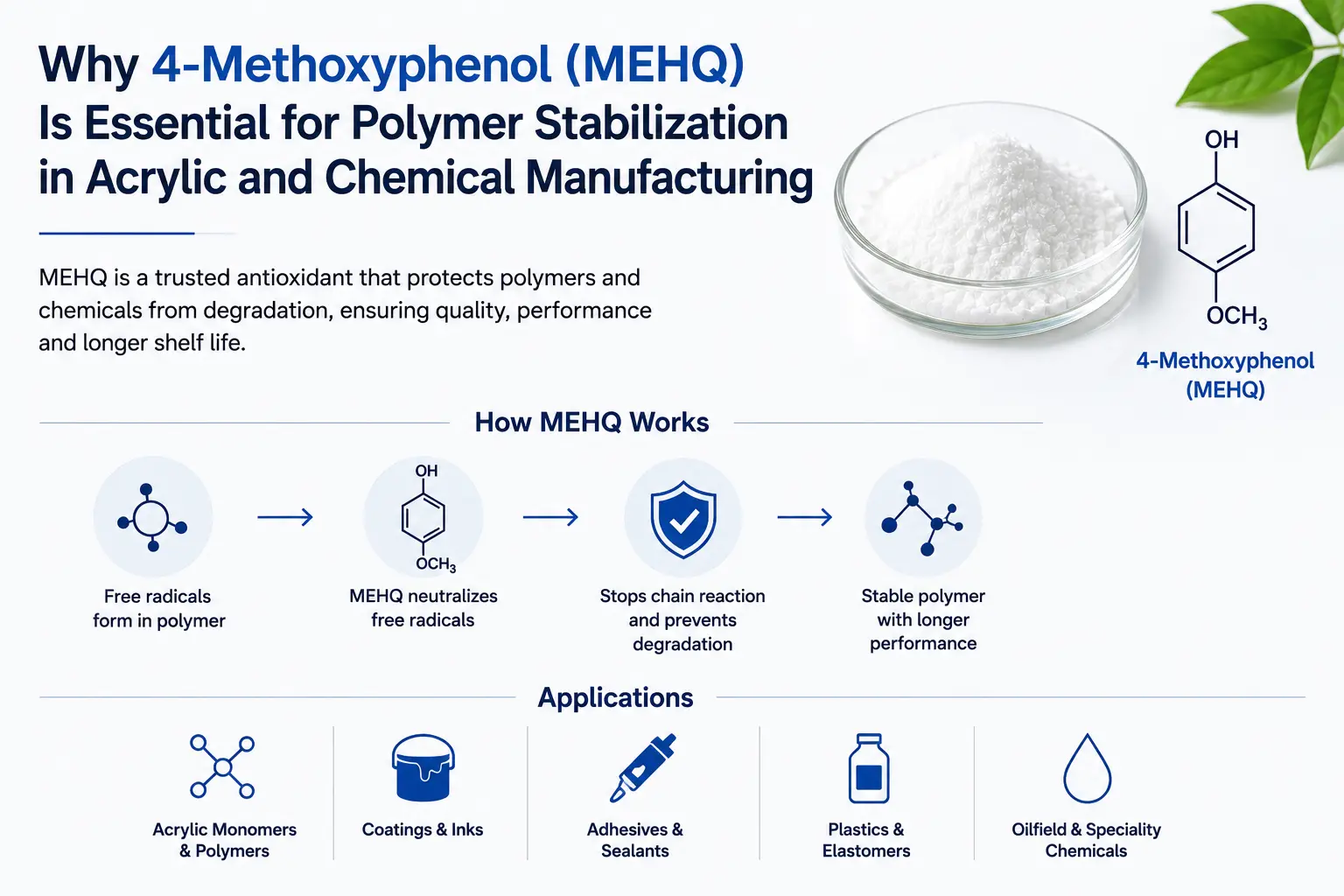
Why 4-Methoxyphenol (MEHQ) Is Essential for Polymer Stabilization in Acrylic and Chemical Manufacturing
Posted on: April 20, 2026
A simple guide to why 4-Methoxyphenol remains important wherever reactive monomers need stability, control, and safer handling.
Reactive monomers are useful, but they can also become difficult to manage if they are not stabilised properly. This is why 4-Methoxyphenol remains important in the acrylic and chemical manufacturing industries. It helps keep reactive systems under control during storage, transport, and handling, so production can stay safer and more consistent.
In many chemical processes, the problem is not whether polymerisation will happen. The real issue is when it happens. If it starts too early, it can affect batch quality, raise safety concerns, and interrupt manufacturing. That is where hydroquinone monomethyl ether becomes valuable. Used in the right way, it helps prevent unwanted reactions before the intended production stage.
What is 4-Methoxyphenol?
4-Methoxyphenol is a phenolic compound widely used as a polymerisation inhibitor. It is also known as hydroquinone monomethyl ether, Mequinol, and is identified by 150-76-5.
In industrial use, MEHQ is valued because it helps stabilise reactive monomer systems, especially acrylic-based ones.
Basic identity at a glance
| Chemical name | 4-Methoxyphenol |
| Other names | hydroquinone monomethyl ether, Mequinol |
| CAS number | 150-76-5 |
| Main industrial role | Polymerisation inhibitor and stabiliser |
| Common form | White crystalline material |
This role may sound simple, but it supports a very important function in manufacturing. It helps keep reactive chemicals stable until the exact point where polymerisation is meant to begin.
Why Do Acrylic And Chemical Systems Need Stabilisation?
Acrylic monomers and similar reactive chemicals can polymerise on their own if conditions are not controlled well. Heat, contamination, oxygen shifts, and storage issues can all affect stability.
If that happens too early, the result can be expensive and disruptive.
Problems caused by poor stabilisation
- Premature polymer formation
- Changes in viscosity
- Fouling in tanks, pipes, or equipment
- Pressure build-up in storage systems
- Off-spec material
- Lower shelf stability
- Unwanted waste and downtime
This is why stabilisers are used in the first place. In acrylic and chemical manufacturing, the goal is to keep monomers stable during storage and movement, then allow polymerisation only under planned process conditions.
How does MEHQ work?
The job of Mequinol is to interfere with the chain reaction that leads to unwanted polymerisation.
In simple terms, many reactive monomers can form free radicals. These radicals trigger a chain reaction, and that chain reaction can quickly turn into unwanted polymer growth. hydroquinone monomethyl ether helps interrupt that process.
What this means in practice
MEHQ helps manufacturers:
- control reactive behaviour during storage
- reduce the risk of premature polymerisation
- improve transport stability
- keep monomers usable for longer
- support cleaner, more predictable production
This function is especially useful in systems where the raw material must stay stable before entering the main production step.
Where is 4-Methoxyphenol Used in Industrial Manufacturing?
The importance of 4-Methoxyphenol becomes clearer when seen through real industrial use. It is not limited to one narrow segment.
- Acrylic monomers and methacrylate systems
This is one of the most important use areas. Acrylic and methacrylate monomers are highly reactive, so they need careful stabilisation during storage and transport.
MEHQ helps maintain control over these monomer systems before they are used in production. This reduces the chances of unwanted polymer build-up and improves process reliability.
- Resin and polymer manufacturing
Reactive ingredients in resin and polymer production need to stay stable until the intended stage of processing. That makes 150-76-5 relevant in environments where reaction timing matters.
Manufacturers rely on stabilisers like MEHQ to protect raw material quality and avoid unnecessary process loss.
- Coatings, adhesives, and sealants
These industries often depend on acrylic or related monomer systems. If those systems lose stability before use, product quality can suffer.
In such applications, MEHQ supports:
- storage stability
- consistent handling
- better process control
- lower risk of batch failure
- Broader chemical manufacturing
Beyond acrylics, hydroquinone monomethyl ether is useful in chemical operations where controlled reactivity matters. This includes specialty chemical handling and production systems that require stable intermediates.
Why is MEHQ Important in Acrylic Manufacturing?
Acrylic manufacturing depends on reactive chemistry. That reactivity is useful during polymer formation, but only when it happens at the right point in the process.
This is why MEHQ matters so much in acrylic systems.
In acrylic manufacturing, MEHQ helps:
- preserve monomer quality during storage
- reduce the risk of early polymerisation
- improve handling safety
- support batch consistency
- cut avoidable waste and process disruption
In simple terms, acrylic manufacturers need the monomer to stay ready, stable, and usable until the exact moment it is meant to react. 4-Methoxyphenol helps make that possible.
Key benefits of using MEHQ
A short list makes practical value easier to understand.
Main benefits of MEHQ in polymer and chemical systems
- Improves storage stability
- Supports safer transport of reactive monomers
- Reduces the risk of premature polymerisation
- Helps maintain batch quality
- Limits process disruption
- Supports cleaner manufacturing flow
- Improves control in acrylic and resin production
These benefits explain why Mequinol remains widely used in stabilisation-focused chemical operations.
Is methoxybenzene the same as 4-Methoxyphenol?
No. This is a useful distinction to make.
Methoxybenzene usually refers to anisole, which is a different compound. 4-Methoxyphenol, hydroquinone monomethyl ether, and Mequinol refer to MEHQ.
This difference matters because the compounds serve different roles in industrial chemistry. So, when the discussion is about polymer stabilisation and inhibitor function, the correct compound is 4-Methoxyphenol, not methoxybenzene.
Industries That Depend on MEHQ-backed Stability
The need for stabilisation is not limited to one sector. Several industries depend on stable reactive systems before final processing begins.
Common sectors include:
- Acrylic manufacturing
- Resin production
- Coatings
- Adhesives
- Sealants
- Specialty chemicals
- Monomer storage and transport operations
In all these areas, the value of 150-76-5 comes from one core strength. It helps keep reactive chemistry under control until the right process stage.
Why Controlled Stabilization Matters in Modern Manufacturing
In acrylic and chemical manufacturing, stable raw materials support safer handling, better process control, and more consistent output. That is why 4-Methoxyphenol remains essential. As hydroquinone monomethyl ether, MEHQ helps reduce the risk of unwanted polymerisation, supports monomer stability, and protects production efficiency in systems where timing and control matter.
With more than 3 decades of experience in the chemical industry, Vinati Organics has built a strong position in specialty chemical manufacturing and supply. Vinati Organics supports industrial value chains that rely on performance-focused chemical solutions, including 4-Methoxyphenol for polymer stabilisation and controlled manufacturing applications. For businesses looking for product specifications, quality-focused supply, or application-relevant support for MEHQ, Vinati Organics is a reliable point of contact. Connect with Vinati Organics to explore the right solution for polymer stabilisation needs.
Related Posts




 K&A
K&A