





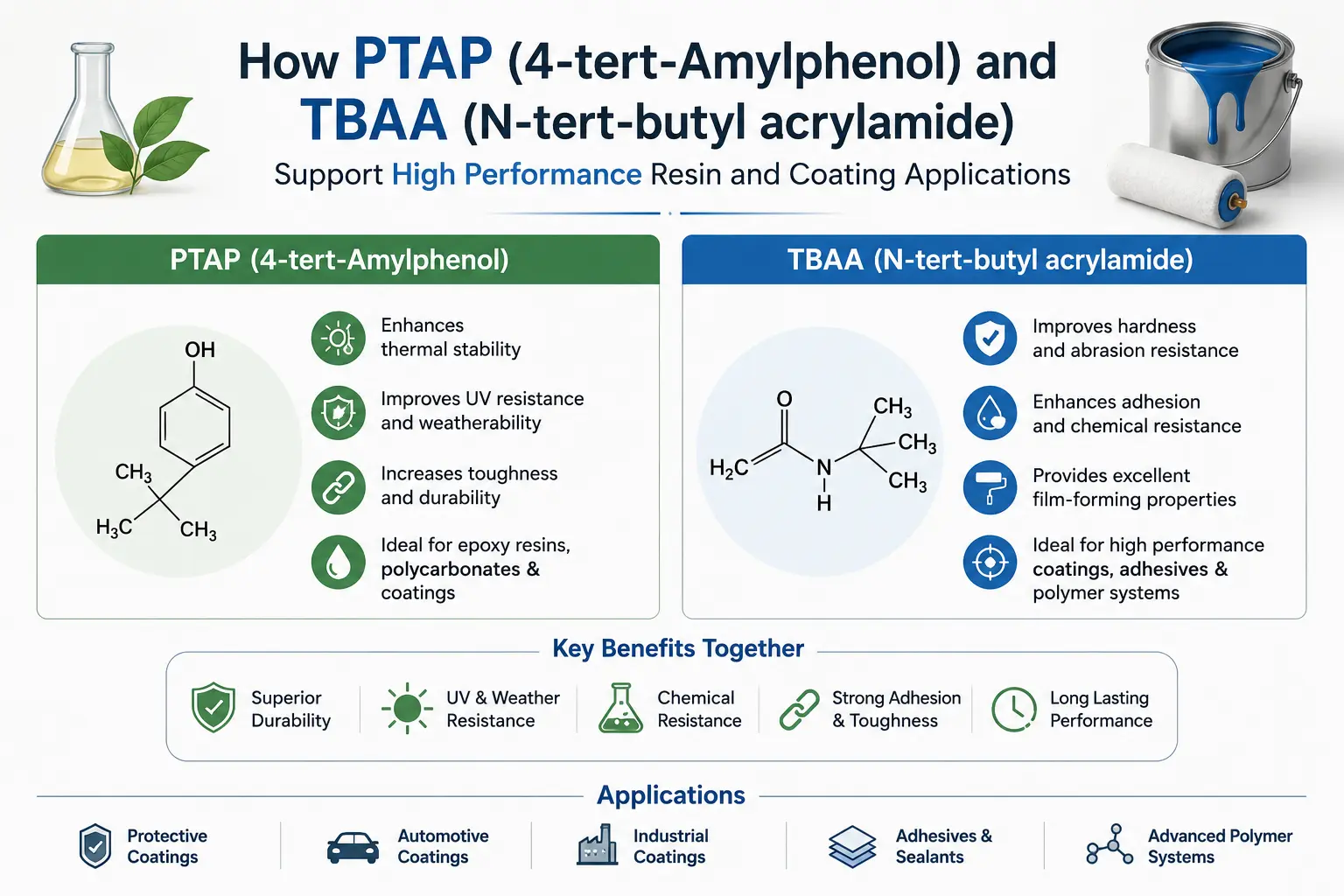
How PTAP (4-tert-Amylphenol) and TBAA (N-tert-butyl acrylamide) Support High Performance Resin and Coating Applications
Posted on: April 27, 2026
A closer look at how PTAP and TBAA help strengthen resin systems, improve coating design, and support advanced industrial formulations.
High-performance resins and coatings depend on more than a strong formula on paper. The real difference often comes from the raw materials used to build stability, durability, and formulation control into the system from the start. This is where PTAP and TBAA become important.
Both these products can be used for industrial formulations at a high level, but they are not interchangeable. PTAP, also known as 4-tert-Pentylphenol or 4-t-Amylphenol, is mainly associated with phenolic resin and formulation chemistry. On the other hand, TBAA enhances the monomer’s properties, thereby aiding polymer development and enabling the designer to achieve the desired properties in the polymer system.
Understanding how these two materials work makes it easier to see why they matter in resin and coating applications where performance cannot be left to chance.
What is PTAP?
PTAP refers to para tert-amyl phenol. It is also known as 4-tert-Pentylphenol, 4-t-Amylphenol, and is identified by 80-46-6. In industrial use, PTAP is valued as a phenolic intermediate for resin and formulation applications.
It is commonly associated with:
- phenolic resin systems
- coatings
- adhesives
- lubricants
- rubber and plastics
- specialty chemical formulations
PTAP at a glance
| Common name | PTAP |
| Other names | 4-tert-Pentylphenol, 4-t-Amylphenol |
| CAS number | 80-46-6 |
| Main role | Phenolic intermediate |
| Key use areas | Resins, coatings, adhesives, specialty formulations |
In simple terms, PTAP matters when formulation structure, resin performance, and material stability play central roles.
What is TBAA?
TBAA refers to N-tert-butyl acrylamide, a hydrophobic monomer used in advanced polymer systems and specialty formulations. In discussions on resins and coatings, TBAA is important because it helps formulators build specific performance traits into polymer networks.
TBAA is used in areas such as:
- specialty polymers
- copolymer systems
- coatings
- formulation design
- performance-focused polymer applications
Unlike PTAP, TBAA is not a phenolic resin intermediate. Its value lies in its behaviour as a monomer and its contribution to polymer design.
Why Raw Material Choice Matters in High-performance Formulations
Resins and coatings are expected a deal with a lot of parameters. Depending on the application, they may need to withstand heat, maintain adhesion, withstand stress, provide surface protection, or remain stable under demanding conditions.
That level of performance does not happen by accident. It depends on how the formulation is built.
A high-performance system usually needs support at more than one level:
- the right intermediate for resin chemistry
- the right monomer for polymer design
- stable formulation behaviour
- compatibility with the final performance goal
This is why PTAP and TBAA are worth understanding together. One supports resin and formulation chemistry more directly. The other supports polymer structure and formulation flexibility.
How PTAP Supports Resin Performance and Coating Durability
The role of PTAP becomes clearer when looked at through application.
Support in phenolic resin systems
One of the most important uses of 4-tert-Pentylphenol is in phenolic resin manufacturing. Phenolic resins are used where durability, thermal resistance, and dependable material behaviour matter.
In these systems, PTAP supports chemistry linked to:
- formulation strength
- resin performance
- heat resistance
- stability in end-use applications
This makes 4-t-Amylphenol relevant in industrial segments where resin quality directly affects final product performance.
Relevance in coatings and adhesives
Coatings and adhesives depend heavily on the chemistry behind the formulation. When raw materials are selected carefully, the final system is more likely to deliver the expected performance.
PTAP is useful in these areas because it supports resin-linked chemistry that contributes to:
- formulation balance
- performance consistency
- durability in demanding use environments
Broader formulation value
The industrial value of PTAP is not limited to one narrow segment. PTAP also appears in applications related to lubricants, rubber, plastics, and specialty chemicals. That broader relevance makes it a useful material in industrial manufacturing where formulation quality matters across product categories.
How TBAA Supports High-performance Coating and Polymer Applications
If PTAP supports performance through resin-linked chemistry, TBAA supports performance through monomer design.
Functional Monomer in Advanced Polymer Systems
TBAA is used in specialty polymers and copolymer systems where the formulator wants additional control over the structure of the finished polymers. This is important because of the need for advanced materials design.
The key applications of TBAA are in the following areas:
- Compatibility
- Thermal Stability
- Flexibility
- Tuning performance in specialty systems
Use in Coating Formulations
Coating systems have evolved from simple surface coatings to systems that must perform under varying conditions, like temperature variation. They must provide consistent performance over time while maintaining coating quality.
This is where TBAA can be used. It is a monomer, and as such, it can support coating systems.
Copolymer design flexibility
Another important advantage of TBAA is formulation flexibility. It can be used in copolymer systems with other monomers, helping manufacturers shape the final polymer according to application needs.
That is valuable in industrial coating and specialty polymer development, where the end-use requirement may vary widely from one system to another.
PTAP vs TBAA: What is the difference?
Both materials support high-performance industrial applications, but the role of each one is different.
| Full identity | 4-tert-Pentylphenol / 4-t-Amylphenol / CAS 80-46-6 | N-tert-butyl acrylamide / CAS 107-58-4 |
| Main role | Phenolic intermediate | Functional monomer |
| Main value | Supports resin and formulation chemistry | Supports polymer and copolymer design |
| Strong use areas | Phenolic resins, coatings, adhesives | Coatings, specialty polymers, advanced formulations |
| Why it matters | Helps build formulation strength and stability | Helps build targeted polymer performance |
This difference is important because it shapes how each material is selected. PTAP helps where resin-related chemistry matters more. TBAA helps where polymer design and performance tuning are a bigger priority.
Why Both Matter in High-performance Resin and Coating Systems
In many industrial applications, performance does not come from one ingredient alone. It comes from how different materials support the system at different stages.
PTAP contributes through:
- resin-focused chemistry
- phenolic formulation support
- coating and adhesive relevance
- broader specialty formulation value
TBAA contributes through:
- monomer-level performance support
- polymer structure design
- coating system flexibility
- specialty copolymer development
Together, these materials show how advanced formulations depend on the right chemical building blocks. One helps strengthen the formulation base. The other helps shape the polymer system behind performance.
Industries And Formulations Where This Chemistry Matters Most
The value of PTAP and TBAA becomes especially clear in sectors such as:
- industrial coatings
- phenolic resin systems
- adhesives
- specialty polymers
- rubber and plastics
- lubricant-related formulations
- specialty chemical manufacturing
In all of these areas, raw material selection affects how well the final system performs in real use.
Building Better Formulations with the Right Chemical Support
High-performance resin and coating applications need chemicals that support the system with clear purpose. PTAP, including 4-tert-Pentylphenol, 4-t-Amylphenol, and 80-46-6, plays an important role in resin and formulation chemistry. TBAA supports advanced polymer and coating systems through monomer-level performance and formulation flexibility. When used appropriately, these materials help manufacturers develop stronger, more reliable industrial formulations.
Vinati Organics brings specialty chemical expertise to industrial applications where formulation quality, consistency, and performance matter. Bulk supply solutions for PTAP and TBAA support resin, coating, and specialty polymer requirements across industrial manufacturing environments. For businesses seeking dependable supply, product specifications, or application-focused support for these materials, Vinati Organics offers a strong, industry-backed solution. Connect with Vinati Organics to explore bulk supply for industrial applications.
Related Posts





 K&A
K&A