





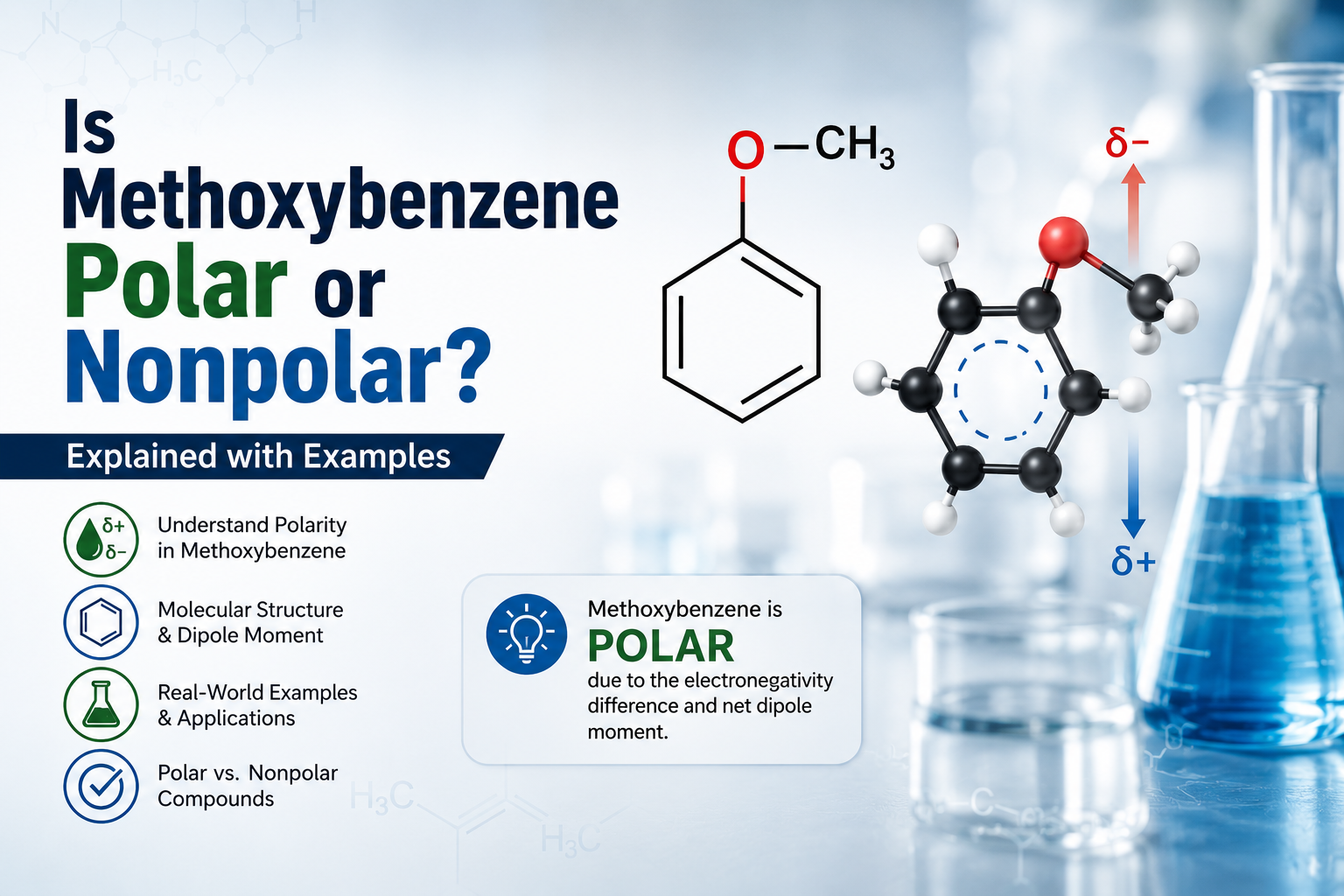
Is Methoxybenzene Polar or Nonpolar? Explained with Examples
Posted on: May 18, 2026
Understanding polarity in aromatic compounds can be tricky. This blog explains where methoxybenzene stands and how its structure defines its behaviour.
Every organic compound behaves differently based on its structure, and this directly affects its chemical properties. Methoxybenzene, commonly known in organic chemistry as anisole, is a compound that is widely studied for its molecular behaviour.
It is an aromatic compound consisting of a benzene ring bearing a methoxy group. This structural combination creates subtle electronic effects that are important in organic chemistry. Understanding its polarity helps predict its behaviour in different environments, especially in solvent selection and reaction design.
In many chemistry discussions, anisole is often used as the standard name, while methoxybenzene is used as the structural description of the same molecule. This compound is frequently referenced to explain how functional groups influence aromatic systems.
Overall, methoxybenzene is a key example for understanding intermediate polarity in organic chemistry.
Quick Answer – Polarity of Methoxybenzene
Before delving into the chemistry, it is important to first understand the compound’s direct classification. Methoxybenzene does not fall into a strictly polar or nonpolar category.
Classification overview
| Property | Behaviour |
| Polarity | Weakly polar |
| Dominant structure | Aromatic ring |
| Key influence | Methoxy group (-OCH₃) |
It shows weak polarity because of the oxygen atom present in its structure. However, the overall aromatic system reduces strong dipole effects.
This makes it behave differently from strongly polar compounds such as alcohol and water. Instead, it shows a balanced chemical nature. In most chemical classifications, methoxybenzene is considered weakly polar rather than fully polar or nonpolar.
Chemical Structure Analysis of Methoxybenzene
To understand polarity, it is important to first break down the molecular structure. The structure of methoxybenzene determines how electrons are distributed across the molecule.
Structural breakdown (step-by-step):
- The benzene ring provides a stable and symmetrical electron system
- The methoxy group introduces a slight electron imbalance
- Oxygen attracts electron density more strongly than carbon
- Overall dipole remains weak due to ring symmetry
The benzene ring plays a major role in balancing electron distribution. At the same time, the methoxy group imparts a small degree of polarity. This combination prevents the molecule from becoming strongly polar. Instead, it stays in a weakly polar state.
It is often used in organic chemistry to demonstrate how functional groups influence aromatic systems. This makes methoxybenzene a key learning example.
Why Methoxybenzene Shows Weak Polarity
Polarity in organic compounds depends on how electrons are shared within the molecule. Methoxybenzene shows weak polarity due to uneven but balanced electron distribution.
Key reasons explained simply:
- Oxygen is highly electronegative compared to carbon
- This creates a partial negative charge on oxygen
- A small dipole moment is formed in the molecule
- The benzene ring reduces the overall polarity effect
The methoxy group introduces polarity into the structure. However, the aromatic ring prevents it from becoming dominant. This results in weak polarity rather than a strong polar behaviour. In practical chemistry, this affects how the compound interacts with solvents.
In methoxybenzene, this balance between structure and electronegativity defines its intermediate nature.
Factors That Influence Polarity in Methoxybenzene
Understanding polarity is not only about classification but also about the factors that control it. In methoxybenzene, several molecular properties interact to confer its weak polarity.
- Electronegativity difference
Oxygen in the methoxy group attracts electrons more strongly than carbon atoms. This creates a small charge imbalance, which contributes to slight polarity in the molecule.
- Molecular symmetry
The benzene ring is highly symmetrical in nature. This symmetry distributes electron density evenly and reduces overall dipole strength.
- Functional group effect
The methoxy (-OCH₃) group is the main source of polarity. However, its influence is limited due to the dominance of the aromatic ring.
- Electron resonance in aromatic ring
The benzene system stabilises electrons through resonance. This reduces the impact of localised charges and weakens overall polarity.
Together, these factors explain why methoxybenzene does not behave as a strongly polar compound. It clearly shows how structural balance determines molecular behaviour in organic chemistry.
Solvent Behaviour and Real Examples of methoxybenzene
Chemical behaviour becomes easier to understand when observed in real environments. Methoxybenzene shows different solubility patterns depending on the solvent used.
Solvent-based behaviour
- Water: Very low solubility due to polarity mismatch
- Ethanol: Moderate solubility due to partial compatibility
- Ether: High solubility due to similar organic nature
These patterns clearly show that methoxybenzene does not behave like a strongly polar compound.
It is commonly used in organic reactions where non-aqueous solvents are preferred. This ensures better stability and reaction control. In laboratory conditions, it is mostly used in organic solvent systems rather than water-based systems.
Comparison with Related Compounds
Understanding polarity becomes easier when compounds are compared side by side. The position of anisole becomes clearer when compared with similar molecules.
Structured comparison table:
| Compound | Polarity | Key Reason |
| Benzene | Nonpolar | Symmetrical electron distribution |
| Methoxybenzene | Weakly polar | Methoxy group effect |
| Phenol | Polar | Hydrogen bonding capability |
Benzene remains completely nonpolar due to perfect symmetry. Phenol, on the other hand, is strongly polar because of hydrogen bonding.
Methoxybenzene lies between these two extremes. It shows limited polarity due to oxygen presence but lacks strong intermolecular bonding.
This comparison clearly places methoxybenzene in the weakly polar category.
Key Takeaways on Methoxybenzene
Summarising the concept helps in clearly understanding the chemical nature of this compound. The behaviour of methoxybenzene is best explained through its structure and molecular interactions.
Key points
- It is a weakly polar aromatic compound
- Polarity is mainly driven by the methoxy group
- The benzene ring reduces the overall dipole effect
- It shows better compatibility with organic solvents than water
In industrial chemical applications, Vinati Organics supports research and manufacturing needs by offering specialty chemical solutions that help industries handle complex aromatic compounds more efficiently. They focus on maintaining consistent quality and reliable chemical performance for various processing environments.
This makes their solutions relevant to applications in which compounds like anisole are studied or used in controlled formulations.
Overall, methoxybenzene is best described as a weakly polar molecule with balanced structural behaviour, rather than strictly polar or nonpolar.
If you are looking for reliable industrial-grade chemical solutions and specialty compounds for research or manufacturing needs, connect with them to explore their product range and technical support.
Related Posts









 K&A
K&A