




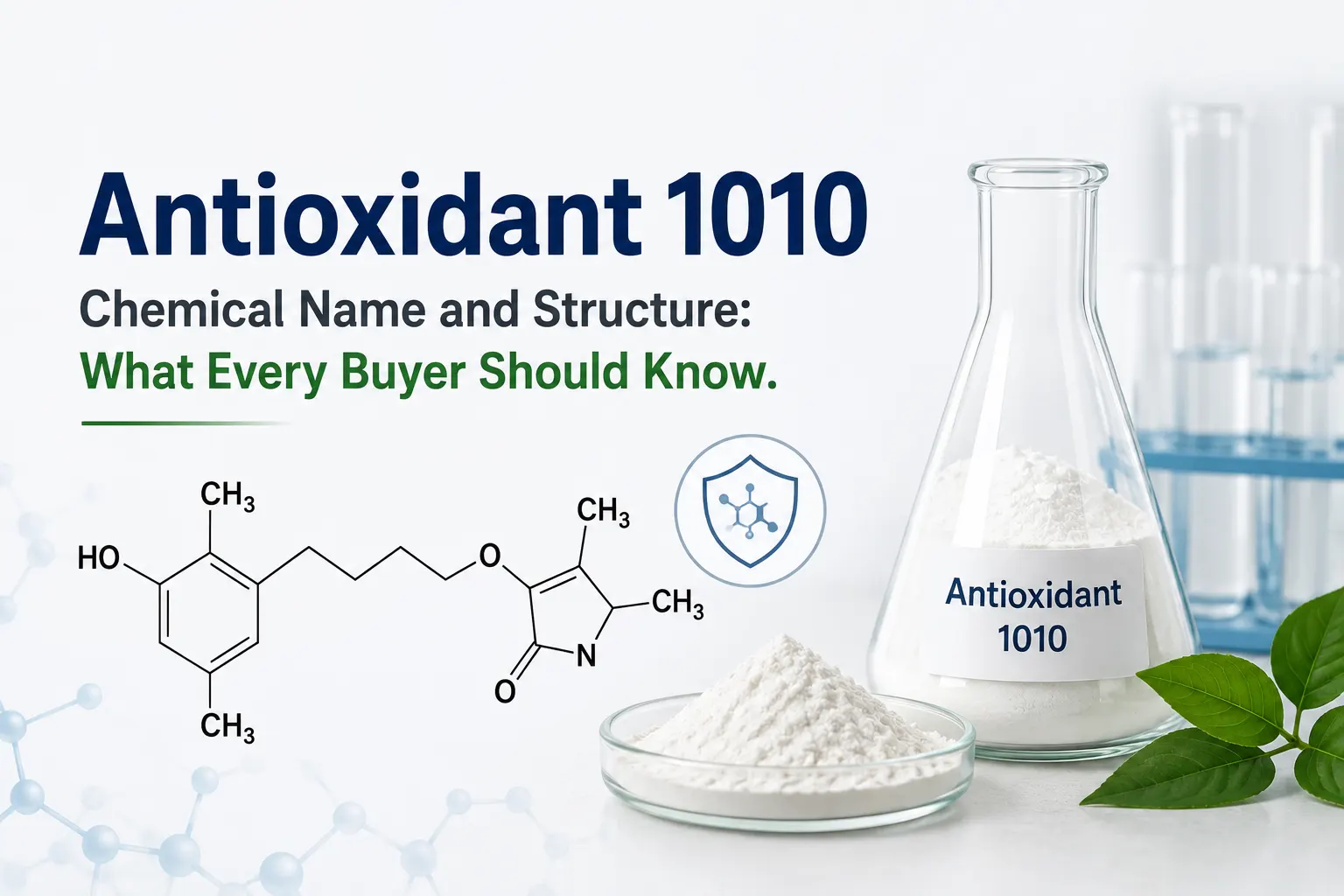
Antioxidant 1010 Chemical Name and Structure: What Every Buyer Should Know.
Posted on: March 20, 2026
Choosing the right primary antioxidant starts with clarity understanding the chemical identity, structure, and role of antioxidant 1010 helps buyers compare it confidently with alternatives like antioxidant 1076 or antioxidant B215.
Plastics do not fail overnight. They slowly degrade because of heat and oxygen. During processing, like extrusion or moulding, polymers are exposed to high temperatures. Over time, this can cause discolouration, brittleness, and loss of strength.
That is where antioxidants come in.
They protect polymers from thermal and oxidative damage.
Among them, antioxidant 1010 is one of the most widely used options in plastics, elastomers, fibres, and adhesives. Buyers often see it sold under trade names like Irganox 1010, or equivalent grades such as Veenox 1010.
In this blog, we explain:
- The antioxidant 1010 chemical name
- Why CAS 6683-19-8 matters
- Its structure and performance
- How it compares to antioxidant 1076 and antioxidant B215
- What buyers should check before placing an order
What Is Antioxidant 1010? (And Why Is CAS 6683-19-8 Important?)
Antioxidant 1010 is a sterically hindered phenolic primary antioxidant. It is used to protect polymers from degradation caused by heat and oxygen.
The number CAS 6683-19-8 is its unique chemical identification number. This number helps buyers:
- Match technical data sheets
- Verify regulatory listings
- Ensure they are comparing the same molecule across suppliers
When you see:
- Irganox 1010
- Veenox Antioxidant 1010
- Or any other equivalent
And it lists CAS 6683-19-8, it refers to the same core molecule.
Understanding this avoids confusion during procurement.
What Is the Chemical Name of Antioxidant 1010?
The formal antioxidant 1010 chemical name is:
Pentaerythritol tetrakis(3-(3,5-di-tert-butyl-4-hydroxyphenyl)propionate)
That sounds complex. So let’s simplify.
It is called a “sterically hindered phenolic” antioxidant.
What does that mean?
- It contains phenolic OH groups (these provide antioxidant action).
- These OH groups are protected by bulky side groups.
- This structure makes the molecule stable and effective.
When a TDS or COA lists:
- The antioxidant 1010 chemical name
- Along with CAS 6683-19-8
It confirms the identity of the same molecule sold as Irganox 1010 or Veenox 1010.
How Is Antioxidant 1010 Structured at the Molecular Level?
The structure of antioxidant 1010 explains its performance.
Here are its key features:
- Central Core
It has a pentaerythritol core.
- Four Phenolic Groups
It contains four ester-linked phenolic groups. This gives it multi-functional antioxidant sites.
- High Molecular Weight
Because of its large size, it has:
- Very low volatility
- Low migration
- Strong resistance to extraction
- Typical Properties
- White, free-flowing powder
- Melting range around 110–125 °C
- High flash point (around 297 °C)
This structure allows it to function as a strong primary antioxidant, especially during high-temperature polymer processing.
Where Is Antioxidant 1010 Used and Why?
Antioxidant 1010 (CAS 6683-19-8) is widely used in:
- Polyethylene (PE)
- Polypropylene (PP)
- Engineering plastics
- Synthetic fibers
- Elastomers
- Adhesives
- Coatings
Why is it preferred?
Because it:
- Withstands high processing temperatures
- Has low volatility
- Provides long-term thermal stability
- Maintains polymer colour
In processes like extrusion, injection moulding, and film blowing, its high molecular weight prevents loss during heating.
In some applications, antioxidant 1010 may also be approved for use in food-contact polymers, depending on region and regulations. Buyers must always verify compliance for their specific market.
How Does Antioxidant 1010 Work as a Primary Antioxidant?
A primary antioxidant stops degradation at the source.
Here is how it works:
During processing, heat and oxygen create free radicals in polymers. These radicals attack polymer chains, causing:
- Chain breakage
- Embrittlement
- Discoloration
Antioxidant 1010 (CAS 6683-19-8) donates hydrogen from its phenolic groups. This neutralizes free radicals and stops the chain reaction.
As a result:
- Polymer chains remain intact
- Mechanical properties are preserved
- Colour stability improves
In real formulations, antioxidant 1010 is often combined with secondary antioxidants such as phosphites. This creates a synergistic stabilization system.
Antioxidant 1010 vs Antioxidant 1076 vs Antioxidant B215: What’s the Difference for Buyers?
Let’s simplify the comparison.
Antioxidant 1076
- Also a phenolic primary antioxidant
- Lower molecular weight compared to antioxidant 1010
- Slightly higher volatility
Antioxidant B215
- Usually a blend
- Combines phenolic and phosphite components
- Acts as a processing + long-term stabilization package
Here’s a quick comparison:
| Parameter | Antioxidant 1010 (CAS 6683-19-8) | Antioxidant 1076 | Antioxidant B215 |
| Type | Phenolic primary antioxidant | Phenolic primary antioxidant | Phenolic + phosphite blend |
| Volatility | Very low | Low | Blend-dependent |
| Typical Use | Long-term stability | Similar polymers | Processing + long-term |
| Dosage | 500–1000 ppm | Similar | Lower due to synergy |
In many systems, antioxidant 1010 serves as the backbone primary antioxidant. Formulators may then adjust with antioxidant 1076 or antioxidant B215 depending on processing needs.
What Technical Data Should Buyers Check Before Ordering?
Before purchasing antioxidant 1010, buyers should review:
✔ CAS number: 6683-19-8
✔ Purity level
✔ Physical form (white free-flowing powder)
✔ Melting range
✔ Ash content
✔ Volatile content
Also check:
- Recommended dosage (commonly 500–1000 ppm)
- Compatibility with phosphites or co-stabilizers
- Application recommendations
In RFQs, specifying:
“Antioxidant 1010, CAS 6683-19-8, Irganox 1010 equivalent”
helps ensure clarity and consistent supplier comparison.
Why Does Supplier Quality Matter for Antioxidant 1010 Buyers?
Even small impurity differences can impact:
- Polymer color
- Long-term stability
- Gel formation
- Line productivity
Inconsistent antioxidant 1010 can lead to:
- Processing shutdowns
- Product rejection
- Export compliance issues
That is why buyers must focus on:
- Batch-to-batch consistency
- Reliable supply
- Strong quality systems
- Regulatory documentation
For demanding applications, high-purity grades like Veenox Antioxidant 1010 from established manufacturers provide better reproducibility.
How to Make a Confident Buying Decision on Antioxidant 1010
Choosing the right antioxidant 1010 (CAS 6683-19-8) starts with understanding its chemical name, molecular structure, and role as a primary antioxidant. When buyers compare antioxidant 1010 with antioxidant 1076 or antioxidant B215, they can better align their selection with processing conditions and long-term performance needs.
Reviewing technical data, verifying CAS 6683-19-8, and understanding formulation synergy ensures the right balance between cost and durability.
At Vinati Organics, we manufacture Veenox Antioxidant 1010 (CAS 6683-19-8), a high-purity sterically hindered phenolic primary antioxidant designed for demanding polymer applications. We focus on world-class manufacturing, strict quality control, and consistent performance across plastics, synthetic fibres, elastomers, and adhesives. Our Veenox 1010 supports high-temperature processing and long-term thermal stabilization.
We invite you to contact us for detailed technical data sheets, formulation guidance, and commercial discussions so we can help optimize your antioxidant 1010, antioxidant 1076, or antioxidant B215 stabilization systems for your specific applications.
Related Posts




 K&A
K&A