





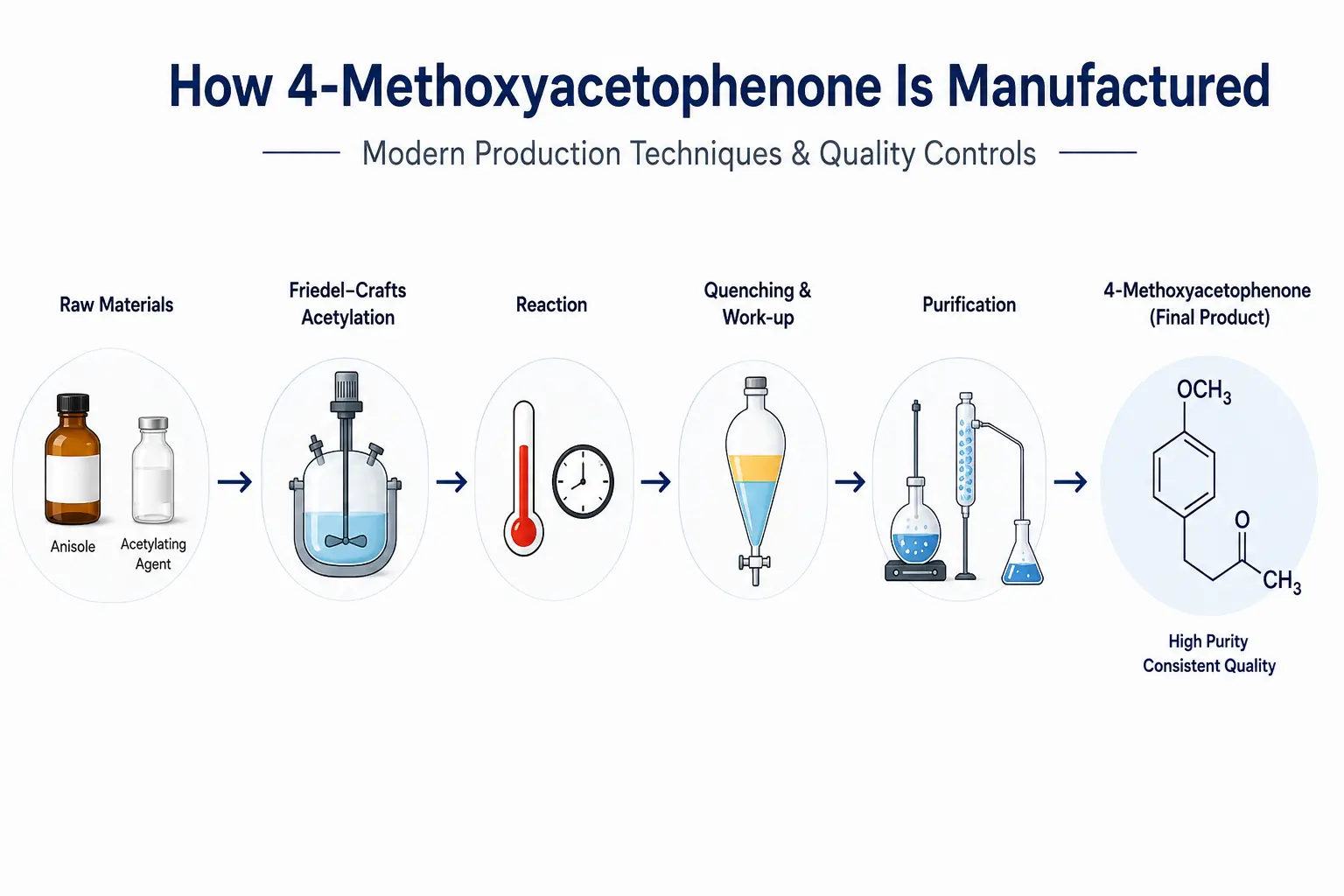
How 4-Methoxyacetophenone Is Manufactured: Modern Production Techniques and Quality Controls.
Posted on: March 20, 2026
If your process relies on 4 methoxy acetophenone, knowing how it is manufactured and controlled can help you avoid inconsistency, reduce risk, and protect production efficiency.
If your formulation depends on reliable chemical intermediates, understanding how they are made is not optional. It directly affects performance, yield, and compliance.
4-methoxy acetophenone (CAS 100-06-1) is one of these important intermediates. Its quality can affect whole production chains in the pharmaceutical, UV absorber, fragrance, and speciality chemical industries.
This guide will break down:
- What 4-methoxyacetophenone is
- How it is produced
- What modern production techniques improve
- Which quality controls are important
- Why process control keeps your operations safe
What Is 4-Methoxyacetophenone (100-06-1)?
4-methoxy acetophenone, also written as 4 methoxy acetophenone or 4 methoxyacetophenone, is an aromatic ketone.
Its:
- Molecular formula: C₉H₁₀O₂
- CAS number: 100-06-1
It appears as a white to pale yellow crystalline solid with a mild odour. It is stable under normal conditions and slightly soluble in water.
Why is this compound important?
Because it acts as a key intermediate in:
- Pharmaceutical synthesis
- UV absorber production (such as sunscreen intermediates)
- Fragrance and flavour compounds
- Specialty chemicals and performance materials
When industrial buyers search for 4-methoxyacetophenone 100-06-1, they are usually looking for reliable purity and batch consistency not just availability.
How Is 4-Methoxyacetophenone Manufactured?
What basic chemistry is involved?
The industrial production of 4-methoxy acetophenone typically uses a reaction known as Friedel–Crafts acylation.
In simple terms:
- Anisole reacts with an acylating agent
- A catalyst is used
- The reaction introduces an acetyl group into the aromatic ring
- The result is 4-methoxyacetophenone
The reaction must be controlled carefully to ensure that the acetyl group attaches in the correct position on the ring. Poor control can lead to unwanted by-products or isomers.
What makes modern production different?
Earlier processes often produced more side products and waste. Today, modern manufacturing techniques focus on:
- Better catalyst systems
- Improved temperature control
- Controlled solvent systems
- Efficient purification steps
Some producers use advanced catalysts or continuous process systems to:
- Improve yield
- Reduce waste
- Increase purity
- Enhance batch consistency
The goal is not just to produce methoxy acetophenone, but to produce it consistently and efficiently.
What Variables Must Be Controlled During Manufacturing?
In industrial production of 4 methoxy acetophenone, several factors affect quality:
Temperature
Too high or too low temperatures can increase impurity formation.
Catalyst concentration
Improper catalyst balance may reduce yield or increase unwanted isomers.
Reaction time
Under-reaction leads to incomplete conversion. Over-reaction may create degradation products.
Purification and crystallisation
This stage removes residual feedstocks and ensures consistent physical form.
Each of these steps directly impacts the final specification of 4-methoxyacetophenone (100-06-1).
What Quality Controls Matter for Industrial Buyers?
When companies source 4 methoxyacetophenone, they usually verify several technical parameters.
Here are the most important ones:
Level of Purity
High purity (usually 98–99% or more, depending on the use) keeps reactions stable downstream.
Even tiny impurities can:
- Lower the yield of the reaction
- Create unwanted by-products
- Raise the costs of purification
Control of Isomers
Positional isomers might change the way reactions happen. This risk is lower when manufacturing is tightly controlled.
Physical Properties
- Melting point
- Appearance
- Moisture content
These confirm identity and consistency.
Documentation
A good supplier gives you:
- CoA (Certificate of Analysis)
- Safety Data Sheet (SDS) that refers to CAS 100-06-1
- Traceability of batches
Without these, regulatory compliance becomes difficult.
What Happens If 4-Methoxyacetophenone Quality Is Poor?
This is a question many buyers ask.
Here’s what can happen if quality control is weak:
- Increased impurity formation in downstream synthesis
- Higher rejection rates
- Longer purification cycles
- Reduced yield
- Higher operational costs
For example, in UV absorber synthesis or pharmaceutical intermediates, even minor deviations in 4-methoxy acetophenone purity can disrupt process efficiency.
In fragrance applications, unwanted impurities may affect aroma profiles.
That is why quality is not just a lab metric it is an operational safeguard.
Why Does Manufacturing Precision Matter for Scale-Up?
Because small differences matter at scale. At the laboratory scale, small amounts of impurities may not seem like a big deal. But at an industrial scale:
- Small differences add up
- Costs go up quickly
- Compliance risk goes up
Consistent production of 4-methoxyacetophenone (100-06-1) makes it easier to scale up and reduces surprises during production runs.
Where Is High-Quality 4-Methoxyacetophenone Used?
Quality-sensitive industries include:
- Pharmaceutical intermediates
- UV absorber production
- Fragrance and cosmetic chemicals
- Agrochemical synthesis
- Specialty materials
In each case, stable and high-purity 4 methoxy acetophenone protects product performance.
Manufacturing Precision Defines Performance
Manufacturing techniques and quality controls are what separate a basic chemical supplier from a reliable industrial partner. The chemistry behind 4-methoxyacetophenone may be well established, but the way it is produced ultimately determines its performance and reliability in industrial applications.
At Vinati Organics, we manufacture 4-methoxy acetophenone (CAS 100-06-1) with a strong focus on controlled processing and consistent quality standards. Our production systems are designed to minimise impurities, maintain batch consistency, and support diverse industrial applications from pharmaceutical intermediates to UV absorber chemistry.
Our expertise in specialty chemical synthesis also includes related aromatic compounds such as 2-Methoxyphenol, which are widely used as intermediates in several performance chemical formulations.
We understand that when you source 4-methoxyacetophenone, you are protecting the stability and efficiency of your downstream processes. That is why we prioritise strict quality monitoring, documentation support, and dependable global supply.
If your operations require precision, reliability, and consistent performance, our expertise in manufacturing methoxy acetophenone ensures your production processes remain stable, efficient, and aligned with demanding industrial standards.
Related Posts





 K&A
K&A