





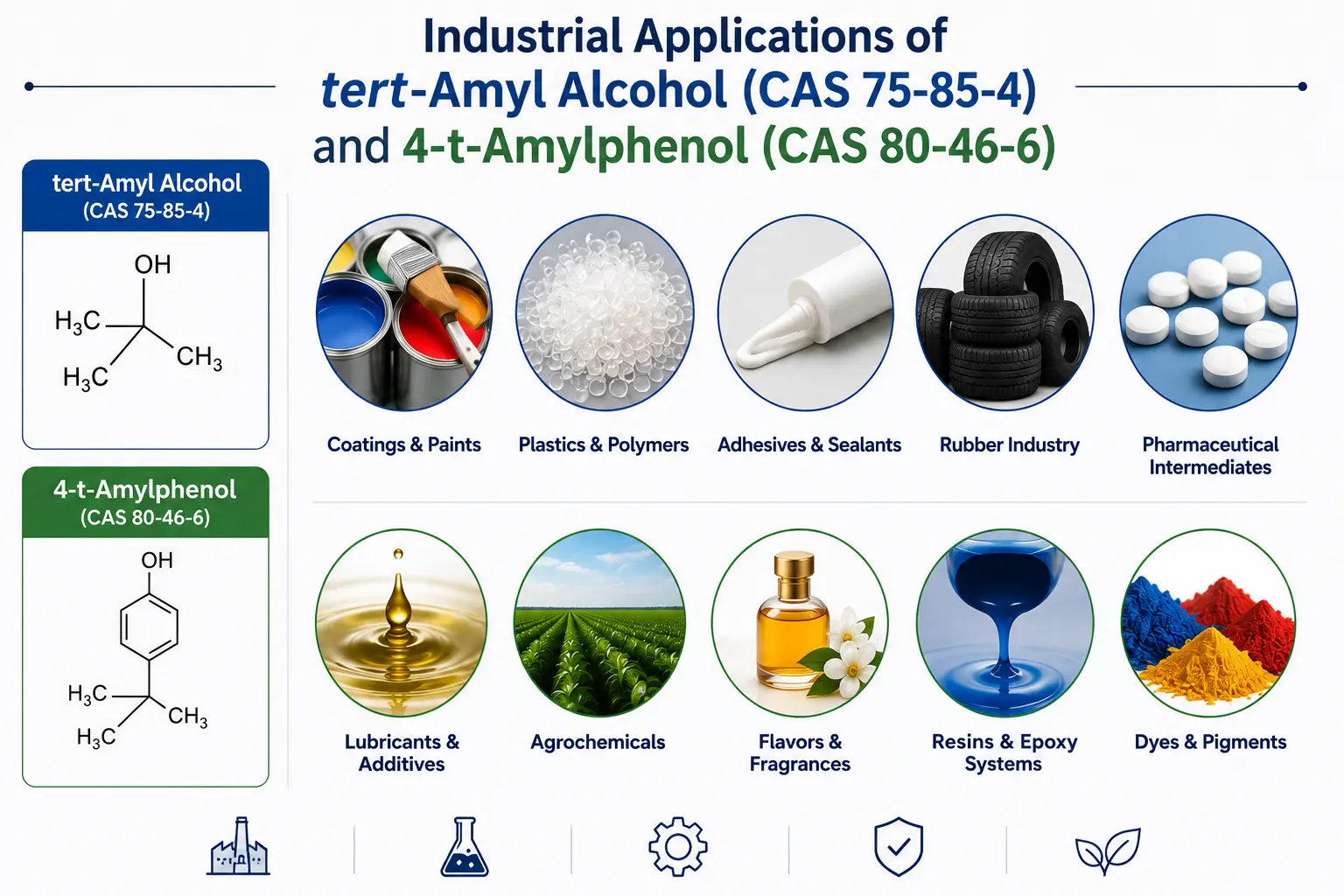
Industrial Applications of tert-Amyl Alcohol (CAS 75-85-4) and 4-t-Amylphenol (CAS 80-46-6)
Posted on: April 13, 2026
Understanding where 75-85-4 and 4-t-Amylphenol fit in coatings, specialty chemicals, and resin-related manufacturing.
Some industrial chemicals work quietly in the background, but their role in product quality, process stability, and formulation performance is hard to ignore. This blog looks at where tert-Amyl alcohol and 4-t-Amylphenol fit in real-world manufacturing.
When specialty chemicals are selected for industrial use, the choice usually comes down to function. One chemical may improve processing, solvency, or synthesis flow. Another may support resin chemistry, coating performance, or formulation strength. That is exactly the case with tert-Amyl alcohol and 4-t-Amylphenol.
Both are useful in industrial manufacturing, but they do very different jobs. tert-Amyl alcohol, also known as 2-Methyl-2-butanol, is widely valued as a solvent and intermediate. 4-t-Amylphenol, on the other hand, is more closely linked with resin systems, coatings, adhesives, and other formulation-driven applications.
Understanding this difference helps explain where each chemical fits and why industries continue to use them.
What Is Tert-amyl Alcohol (CAS 75-85-4)?
Tert-Amyl alcohol is the common name for 2-Methyl-2-butanol, identified by 75-85-4. It is a clear, colourless liquid used in a range of industrial processes where solvent behaviour and chemical reactivity both matter.
Its physical profile makes it useful in manufacturing environments:
- Liquid form makes handling easier in many process setups
- It offers good compatibility with organic systems
- It works well in industrial formulations that need controlled solvency
- It can also act as a chemical intermediate in downstream synthesis
This combination gives tert-Amyl alcohol an important place in specialty manufacturing. It is not limited to one narrow use. It supports production in coatings, specialty chemicals, pharmaceuticals, and other industrial segments where process performance matters.
What is 4-t-Amylphenol and Why is it Used in Specialty Manufacturing?
4-t-Amylphenol is a phenolic compound used mainly as an intermediate in industrial formulations. Unlike tert-Amyl alcohol, this material is not used for simple solvent action. Its role is more structural and formulation-focused.
It is generally handled as a solid chemical and is widely associated with:
- Phenolic resin systems
- Coating formulations
- Adhesives
- Lubricant-related applications
- Other specialty chemical processes
In practical terms, 4-t-Amylphenol matters where chemical stability, resin performance, and formulation strength are important. That makes it especially relevant in industrial sectors that rely on durable materials and performance-driven chemistry.
How tert-Amyl Alcohol is Used Across Industries
The value of tert-Amyl alcohol comes from its flexibility. It can support industrial manufacturing in multiple ways.
- Solvent use in coatings and resin systems
In coatings and related formulations, solvent choice affects how a system mixes, flows, and performs during processing. tert-Amyl alcohol can support such systems by improving solubility and formulation handling.
This matters in applications where:
- Even blending is important
- Controlled processing behaviour is needed
- Formulation consistency affects final product quality
- Intermediate in specialty chemical synthesis
A major use of 2-Methyl-2-butanol is as an intermediate in chemical manufacturing. It helps in the production of esters, additives, and other specialty compounds used further down the value chain.
This makes tert-Amyl alcohol useful in plants that need raw materials with both chemical utility and process compatibility.
- Pharmaceutical and agrochemical processing
In some pharmaceutical and agrochemical manufacturing operations, tert-Amyl alcohol plays a part in the synthesis as well as formulation stages.
Its function here is not so much about the product itself but more about the contribution of the process.
Most of the time, that is how industrial chemicals generate value. The final product usually gets the spotlight, but the intermediate is what makes consistent production possible.
- Fuel, lubricant, and rubber-related uses
Industrial use also extends into:
- lubricant additive systems
- rubber processing support
- speciality blending applications
These uses show that 75-85-4 is not limited to one market. It has a broader industrial presence because of its practical function.
Where 4-t-Amylphenol Fits in Resin, Coating, and Formulation Systems
If tert-Amyl alcohol is mainly valued for process and synthesis support, 4-t-Amylphenol is valued more for what it contributes to formulation chemistry.
Phenolic resin manufacturing
One of the most important uses of 4-t-Amylphenol is in the production of phenolic resins. This is where the chemical becomes especially relevant to industrial applications that demand dependable material performance.
Phenolic resin systems are often chosen where manufacturers need:
- heat resistance
- chemical resistance
- strong bonding performance
- reliable structural behaviour in the final material
Because of this, 4-t-Amylphenol plays a useful role in industrial chemistry, particularly in durable resin systems.
Coatings and adhesives
Coatings and adhesives depend heavily on formulation chemistry. A small change in raw material quality or functionality can affect the end result.
In these areas, 4-t-Amylphenol supports performance-driven systems that need stability and formulation strength. This is one reason it remains important in industrial manufacturing tied to protective coatings and adhesive technologies.
Lubricants, rubber, and plastics
The relevance of 4-t-Amylphenol goes beyond resins. It also appears in other specialty applications connected to:
- lubricants
- rubber
- plastics
- broader industrial formulations
That wider application range strengthens its position as a useful specialty intermediate.
tert-Amyl alcohol vs 4-t-Amylphenol: How Do They Differ?
Although both chemicals are used in industrial manufacturing, their roles are quite different.
| Basis | tert-Amyl alcohol | 4-t-Amylphenol |
| Chemical form | Liquid | Solid |
| Also known as | 2-Methyl-2-butanol | Para tert-amyl phenol |
| Main function | Solvent and intermediate | Resin and formulation intermediate |
| Common industrial use | Coatings, synthesis, pharma, agrochemicals, lubricants | Resins, coatings, adhesives, lubricants |
| Value in manufacturing | Supports process flow and chemical conversion | Supports formulation performance and material properties |
This difference is important. It helps buyers, formulators, and industrial planners match the right chemical to the right production need.
Why These Chemicals Matter in Modern Specialty Manufacturing
Specialty manufacturing depends on precision. Raw materials are chosen for what they do in the process and what they help achieve in the final product.
That is why both chemicals continue to matter.
tert-Amyl alcohol helps with:
- process support
- solvency
- synthesis efficiency
- formulation handling
4-t-Amylphenol supports:
- resin chemistry
- coating-related formulation strength
- adhesive-linked applications
- performance-focused industrial systems
Together, these chemicals show how industrial manufacturing relies on materials that serve specific technical functions. One improves the way production moves. The other supports the way the final formulation performs.
Why These Chemicals Matter in Modern Specialty Manufacturing
Manufacturers today need chemicals that go beyond filling a formula. Every input in a production chain carries a technical responsibility.
tert-Amyl alcohol (75-85-4) contributes at the processing level. It improves solvency, supports synthesis, and helps production run more efficiently. 4-t-Amylphenol contributes at the formulation and material level. It strengthens resin systems, improves coating performance, and gives adhesive and lubricant formulations the stability they need.
Together, these compounds reflect a broader reality in specialty chemical manufacturing: production efficiency and end-use performance both depend on choosing the right chemical for the right function.
Knowing the Right Chemical for the Right Application
Tert-Amyl alcohol (CAS 75-85-4) and 4-t-Amylphenol serve distinct but equally important roles in industrial manufacturing. One supports processing and synthesis. The other drives resin and formulation performance. Understanding that difference helps procurement teams, formulators, and production engineers make better decisions at every stage of the supply chain.
Vinati Organics manufactures and supplies specialty chemicals, including tert-Amyl alcohol and 4-t-Amylphenol, for industries such as coatings, resins, pharmaceuticals, agrochemicals, and specialty formulation-led manufacturing. To explore product specifications, industrial supply support, or application-relevant chemical solutions, connect with Vinati Organics.
Related Posts





 K&A
K&A