





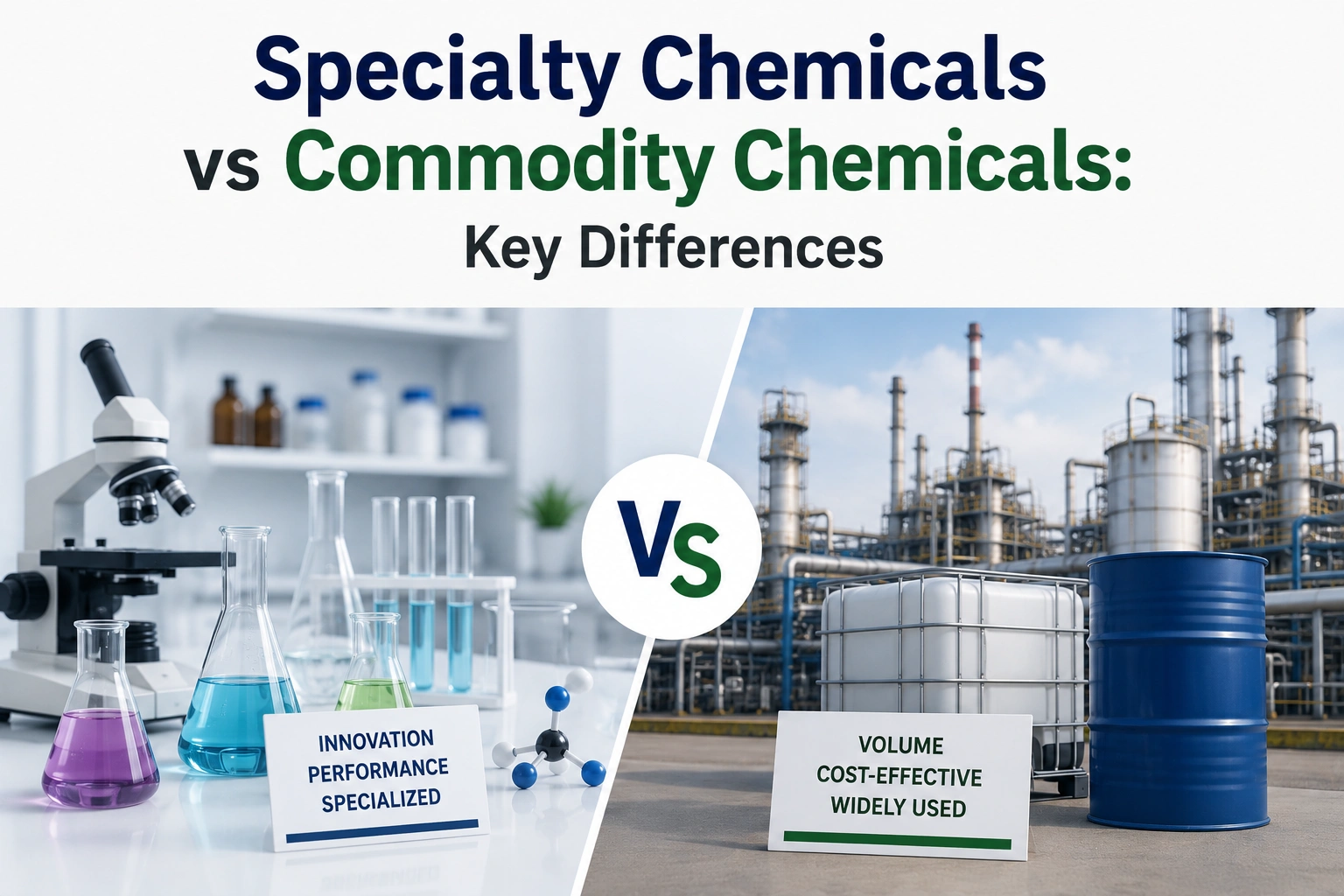
Specialty Chemicals vs Commodity Chemicals: Key Differences
Posted on: August 25, 2026
The chemical industry uses a wide range of products, from basic chemicals made in very large volumes to specialized materials designed for specific industrial needs. Understanding the difference between specialty and commodity chemicals helps B2B buyers make better sourcing and product decisions.
The main difference is not simply the price. It involves product performance, production volume, formulation, application, technical support, and the level of customization required. Industrial chemicals can fall into either category, depending on their properties and intended use.
For manufacturers, the right choice depends on what the chemical needs to achieve. A high-volume process may need a standard commodity chemical, while a demanding application may require a product with precise performance characteristics.
What Are Specialty Chemicals?
Specialty chemicals are products made for specific functions or applications. Their value often comes from their performance rather than the quantity produced.
These chemicals may be used in areas such as plastics, pharmaceuticals, water treatment, construction, coatings, personal care and agrochemicals. Vinati Organics states that its portfolio includes specialty aromatics, specialty monomers, butyl phenols, antioxidants, polymers and inorganic chemicals.
Specialty chemicals often require:
- Specific performance properties
- Controlled purity
- Technical expertise
- Consistent production
- Application-based testing
- Detailed quality control
For buyers, this means product selection can involve more than checking a specification sheet.
The chemical must also perform well in its intended process.
What Are Commodity Chemicals?
Commodity chemicals are generally produced in large volumes and are used across many industries. They are often standardised and available from several suppliers.
Their value is commonly linked to availability, volume, price and consistency. Buyers may use them as basic inputs in manufacturing processes.
Examples can include common solvents, acids, alkalis and other widely used chemical materials.
Unlike many specialty products, commodity chemicals usually have broader applications. A buyer may therefore have several sourcing options.
However, this does not mean that commodity chemicals are less important. They are essential industrial raw materials for many manufacturing operations.
Specialty Chemicals Vs Commodity Chemicals: Key Differences
The differences become clearer when their main characteristics are compared.
| Factor | Specialty Chemicals | Commodity Chemicals |
| Main value | Performance and specific function | Volume and availability |
| Production | Often lower volume | Usually high volume |
| Applications | Specific or specialised | Broad |
| Product specifications | Often more detailed | Usually standardised |
| Customisation | May be possible | Usually limited |
| Technical support | Often important | Generally less application-specific |
| Price basis | Performance and formulation | Market price and production cost |
| Buyer focus | Quality, function and consistency | Cost, supply and consistency |
This comparison shows why the purchasing process can differ between the two categories.
A manufacturer buying a specialty additive may focus on how it performs in a finished product. A buyer sourcing a basic raw material may place greater emphasis on cost and reliable supply.
How Production Volume Affects Chemical Selection
Production volume is one of the clearest differences between the two categories.
Commodity chemicals are often manufactured at high volumes. This helps suppliers meet broad market demand and maintain competitive pricing.
Specialty chemicals may be produced in smaller volumes. Their manufacturing process can involve more specific controls based on the required properties.
For B2B buyers, volume should not be the only consideration.
A chemical that performs better may reduce processing problems or improve the quality of the finished product. In such cases, the higher purchase cost may be justified by the overall process benefit.
Why Performance Matters More for Specialty Chemicals
Performance is central to many specialty chemical applications. For example, plastic antioxidants are used to help protect polymers from degradation caused by factors such as heat and oxidation. Vinati Organics manufactures several antioxidant products under its VEENOX range, including primary phenolic and secondary phosphite antioxidants.
In this type of application, the buyer needs to consider more than the price per kilogram.
Important factors can include:
- Thermal stability
- Compatibility with the polymer
- Processing conditions
- Required dosage
- Product purity
- Storage stability
- Regulatory requirements
The right product should match the manufacturing process.
This is why specialty chemical sourcing often requires a closer discussion between the supplier and the technical team.
How Commodity Chemicals Support Large-Scale Manufacturing
Commodity chemicals remain important because many production processes depend on steady access to basic materials.
They can be used in:
- Chemical processing
- Manufacturing
- Cleaning operations
- Water treatment
- Construction
- Agriculture
- Industrial production
For these applications, buyers often focus on supply continuity, quality consistency and competitive pricing.
The role of industrial raw materials is particularly important in large production environments. A delay in supply can affect several stages of manufacturing.
As a result, buyers should assess supplier capacity and delivery reliability even when sourcing standard chemicals.
How Pricing Differs Between the Two
Price is another major difference. Commodity chemicals usually have a more transparent market price because they are produced in large quantities and are available from many suppliers.
Specialty chemicals can have a higher price because their production may involve specialised processes, research, quality controls and technical development. However, comparing prices alone can be misleading. A specialty product may require a lower dosage or provide better process performance. This can affect the actual cost of using the product.
For B2B buyers, the better question is often: What is the total cost of achieving the required performance? This approach provides a clearer basis for supplier comparison.
What Role Do Chemical Suppliers Play?
The role of chemical suppliers goes beyond delivering products.
For specialty products, buyers may need information about handling, storage, compatibility, application and technical specifications.
A reliable supplier should be able to provide clear product information and consistent batches.
Buyers should assess:
- Product specifications
- Quality control systems
- Manufacturing capacity
- Supply reliability
- Technical documentation
- Packaging options
- Regulatory support
- Export capability
This is especially important when the chemical becomes part of another manufactured product.
A supplier with suitable technical knowledge can also help buyers understand whether a product matches their process requirements.
Where Superplasticizers Fit into the Chemical Industry
Superplasticizers show how specialty chemical products can serve a specific industrial function.
They are used in concrete formulations to improve workability and help reduce water requirements while maintaining the desired properties of the mix.
Vinati Organics manufactures Vinplast-245, an acrylic superplasticizer. The company states that the product provides high fluidity and supports controlled setting and slump retention in concrete applications.
For buyers, product selection depends on the intended concrete formulation and processing requirements.
This is different from sourcing a basic commodity chemical where the main concern may be price and availability.
How Businesses Should Choose Between the Two
The choice should start with the application rather than the product category.
Businesses should first identify:
- What the chemical needs to do
- Where it will be used
- Required purity
- Required volume
- Processing conditions
- Quality standards
- Target production cost
- Supply requirements
If the application needs a specific performance property, a specialty chemical may be more suitable. If the process needs a standard material in large volumes, a commodity chemical may be the more practical choice.
The decision should also consider long-term supply. Consistent quality can be just as important as the initial purchase price.
Making A Better Chemical Sourcing Decision
Specialty and commodity chemicals both have an important role in manufacturing. Neither category is automatically better than the other.
Specialty chemicals are generally selected for specific performance needs. Commodity chemicals are often selected for broad use, volume and availability.
The right option depends on the process, product requirements and business goals. Buyers should compare quality, technical specifications, supply capacity and total usage cost before making a decision.
Vinati Organics focuses on specialty chemicals and organic intermediates for industrial and chemical customers across global markets. Its portfolio covers specialty aromatics, monomers, butyl phenols, antioxidants, polymers and other specialty products. The company also highlights its research and development capabilities and presence across more than 35 countries.
For businesses looking for specialised industrial chemicals, Vinati Organics provides a broad product portfolio for applications across industries. Buyers can contact their team to discuss product specifications and sourcing requirements.
Related Posts





 K&A
K&A