


Guaiacol Manufacturing Methods Explained: Catechol Methylation vs Other Routes
Posted on: August 25, 2026
Guaiacol is a useful aromatic compound with applications across pharmaceuticals, flavours and fragrances, personal care, agrochemicals and other specialty chemical sectors. It is also known as 2-methoxyphenol and has the CAS number 90-05-1.
For manufacturers, the production route matters as much as the final product. The choice of raw materials, catalysts, reaction steps and purification methods can affect yield, purity, cost and process control.
Catechol methylation is one recognised route for making guaiacol. However, it is not the only approach. Industrial chemistry also explores routes based on phenol and anisole, each with its own process considerations.
Understanding these routes helps buyers, process engineers and chemical companies make better decisions when evaluating guaiacol supply.
What Is Guaiacol and Why Is It Important?
Guaiacol is an aromatic organic compound containing both a hydroxyl group and a methoxy group. This combination gives it chemical properties that make it useful as a building block for several industrial products.
The compound is often described as a methoxy phenol because its structure contains a methoxy group attached to a phenolic ring.
It is also part of a wider group of phenolic compounds used in specialty chemical manufacturing.
Guaiacol has applications in several areas, including:
- Pharmaceutical formulations and intermediates
- Flavour and fragrance production
- Agrochemical synthesis
- Personal care products
- Polymer-related applications
- Specialty chemical manufacturing
It is also used as a raw material for vanillin production and as an intermediate in other chemical processes.
Because guaiacol can serve different industrial needs, manufacturers need a production method that offers consistent quality and reliable process control.
How Catechol Methylation Produces Guaiacol
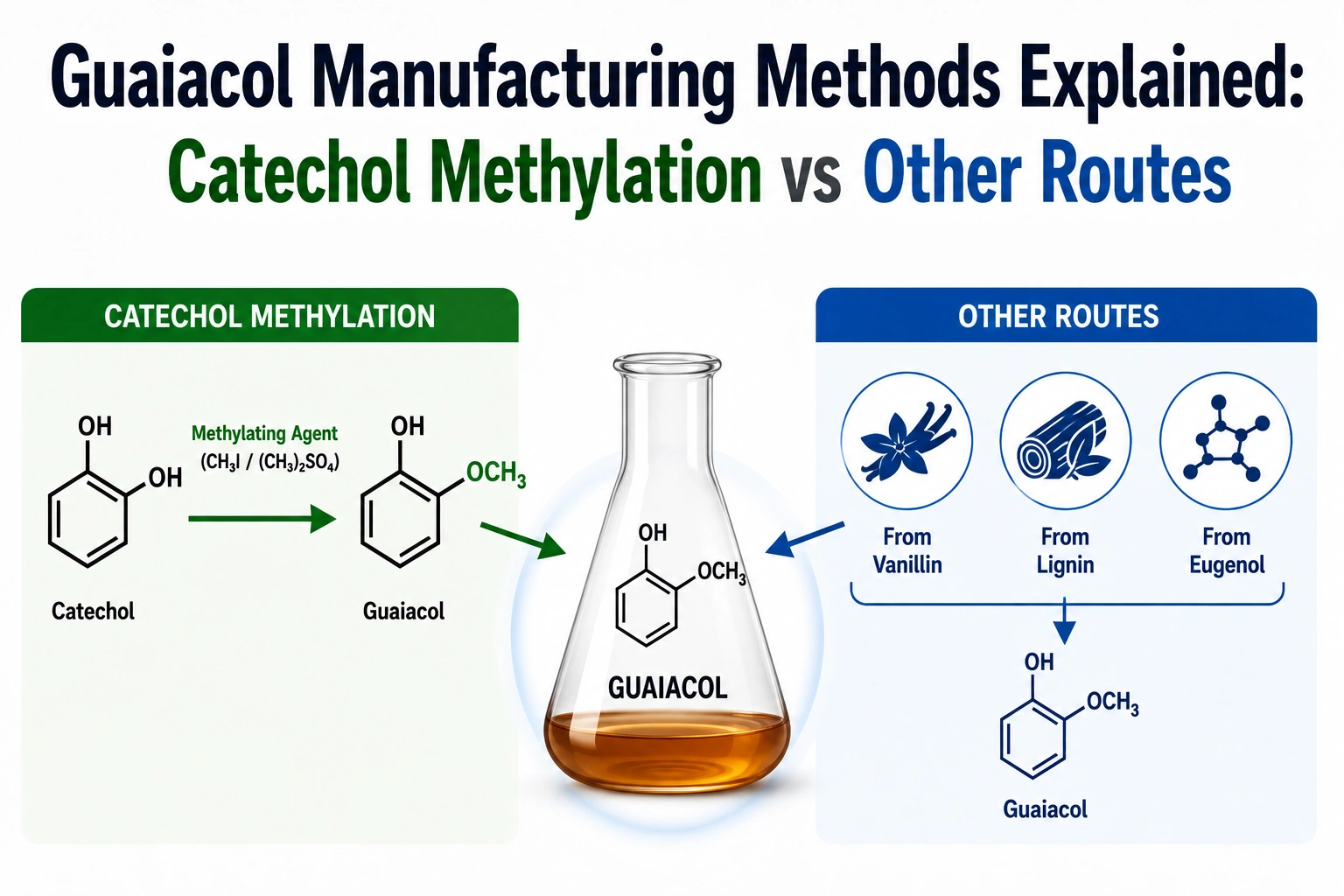
Catechol methylation is one of the most direct ways to understand guaiacol formation. Catechol contains two hydroxyl groups attached to an aromatic ring. During selective methylation, one of these hydroxyl groups is converted into a methoxy group. The result is guaiacol. In simple terms, the process can be viewed as: Catechol → Selective methylation → Guaiacol
The key challenge is selectivity. Catechol has two hydroxyl groups, so the reaction must favour methylation at only one position.
If both hydroxyl groups undergo methylation, unwanted dimethoxy products can form. This creates an additional separation requirement. The choice of methylating agent and reaction conditions therefore plays an important role.
A controlled methylation reaction can help improve selectivity and product quality. The catalyst, temperature, reactant ratio and residence time must be managed carefully.
This is why catechol methylation can be useful for producing guaiacol, but the overall process needs effective reaction and purification control.
Why Selectivity Matters in Catechol-Based Production
The main issue with catechol methylation is not simply producing a methylated product. The process must produce the right product in the right proportion.
A poorly controlled reaction may result in:
- Unreacted catechol
- Guaiacol
- Dimethoxybenzene derivatives
- Other reaction by-products
This mixture can increase purification requirements.
For industrial manufacturers, high selectivity can reduce material losses and make downstream processing easier.
The purity of the starting catechol also matters. Impurities can affect catalyst performance and may introduce additional compounds into the final product. This is a common consideration when producing chemical intermediates for further industrial use.
The same principle applies across many aromatic compounds. A reaction route may appear simple on paper but still require careful control at commercial scale.
The Phenol-To-Anisole Route Offers Another Approach
Catechol methylation is not the only possible route to guaiacol. Another approach starts with phenol. Phenol can first undergo methylation to form anisole. The anisole can then be hydroxylated to form guaiacol. The basic sequence is Phenol → Anisole → Guaiacol
This route separates the methylation and hydroxylation steps. Published process literature describes a phenol-based method in which phenol reacts with a methylating agent to produce anisole, followed by a hydroxylation step that forms guaiacol. This approach can be attractive for continuous industrial production because the two main chemical transformations can be managed separately.
Vinati Organics has also publicly discussed a route involving phenol, methanol and anisole, followed by production of MEHQ and guaiacol. Its published investor material states that phenol is converted to anisole, which is then used to make MEHQ and guaiacol.
Catechol Methylation Vs Phenol-Based Production
Both routes can produce guaiacol, but they approach the target molecule differently.
| Factor | Catechol Methylation | Phenol-Based Route |
| Starting material | Catechol | Phenol |
| Main intermediate | Guaiacol directly | Anisole |
| Key reaction | Selective methylation | Methylation followed by hydroxylation |
| Main challenge | Avoiding over-methylation | Controlling hydroxylation |
| Process design | Can involve selective conversion and purification | Uses sequential reaction stages |
| Industrial focus | Selectivity and separation | Yield, purity and process integration |
The choice depends on raw material availability, plant design, catalyst systems and required product specifications. Neither route should be viewed as suitable for every production setting.
Where Other Phenolic Products Fit In
Guaiacol belongs to a wider family of specialty aromatic products. For example, 2 4 di tert butylphenol is another industrially relevant phenolic compound. It is used in areas connected with specialty chemicals and antioxidant production. PTAP is also a separate specialty product used in applications such as resins. Vinati Organics lists PTAP among the products being manufactured through its Veeral Organics subsidiary.
These products are not alternative guaiacol manufacturing routes. They show how phenolic compounds can form part of a broader specialty chemical portfolio.
Similarly, 2 4 di tert butylphenol has its own manufacturing requirements and applications. PTAP should therefore be considered a separate product rather than a step in guaiacol production. Understanding these differences is important when assessing specialty chemical suppliers.
How Manufacturers Compare Guaiacol Production Routes
Choosing a manufacturing route involves more than comparing the number of reaction steps. Manufacturers generally need to assess several practical factors.
- Raw Material Availability
A reliable supply of starting materials is essential. The cost and availability of phenol or catechol can influence the economics of a route.
- Reaction Selectivity
A selective methylation reaction can help limit unwanted products. Hydroxylation also needs careful control when using an anisole-based process.
- Product Purity
High-purity guaiacol may be required for applications involving pharmaceuticals, flavours, fragrances and other specialty products.
Vinati Organics lists guaiacol with a minimum GC purity specification of 99.5% on its product page.
- Process Integration
Integrated manufacturing can help improve control over raw materials and intermediate streams.
This becomes particularly useful when several chemical intermediates are produced within the same specialty chemical network.
- Scale And Consistency
A commercial process must deliver consistent output over repeated production cycles. This is where industrial process design becomes different from laboratory synthesis.
Why Industrial-Scale Guaiacol Production Needs Tight Control
Producing guaiacol at commercial scale requires control at every stage.
Raw materials need consistent specifications. Reaction conditions need close monitoring. Separation must remove unwanted components without affecting product quality.
Storage and handling also need to match the chemical’s physical properties.
Guaiacol is generally supplied as a clear, colourless to yellowish liquid. Vinati Organics specifies water content at not more than 0.5% w/w and total impurities below 0.5% for its listed product.
Such specifications matter to buyers because product consistency can directly affect downstream processing. The same approach applies when handling other aromatic compounds and phenolic compounds used as industrial raw materials.
What Buyers Should Check Before Choosing a Supplier
A production route tells only part of the story. Industrial buyers should also examine the supplier’s ability to maintain quality across batches.
Useful checks include:
- Product purity and specification
- Available quality documentation
- Manufacturing capacity
- Batch consistency
- Packaging and storage conditions
- Technical support
- Supply reliability
- Export capabilities
A supplier with experience in specialty chemicals may also understand the wider needs of customers using guaiacol as one of several chemical intermediates.
Buyers should also confirm whether the material meets the specifications required for their own process.
Choosing A Reliable Route for Long-Term Supply
Guaiacol manufacturing can follow different chemical pathways, and each has its own strengths and process challenges.
Catechol methylation provides a direct route through selective conversion of one hydroxyl group. A phenol-based process can instead use anisole as an intermediate before hydroxylation. Both approaches require careful reaction control, purification and quality testing.
For buyers, the best choice is not simply the route with fewer steps. Consistent purity, dependable production, raw material security and technical capability also matter.
Vinati Organics operates across specialty chemicals and organic intermediates, with a presence in more than 35 countries. Its Veeral Organics subsidiary focuses on niche specialty chemicals, including guaiacol.
Their published guaiacol specifications and information on manufacturing routes provide useful context for industrial buyers assessing supply options. Businesses looking for consistent guaiacol supply can contact Vinati Organics to discuss product specifications and requirements.
Related Posts





 K&A
K&A