





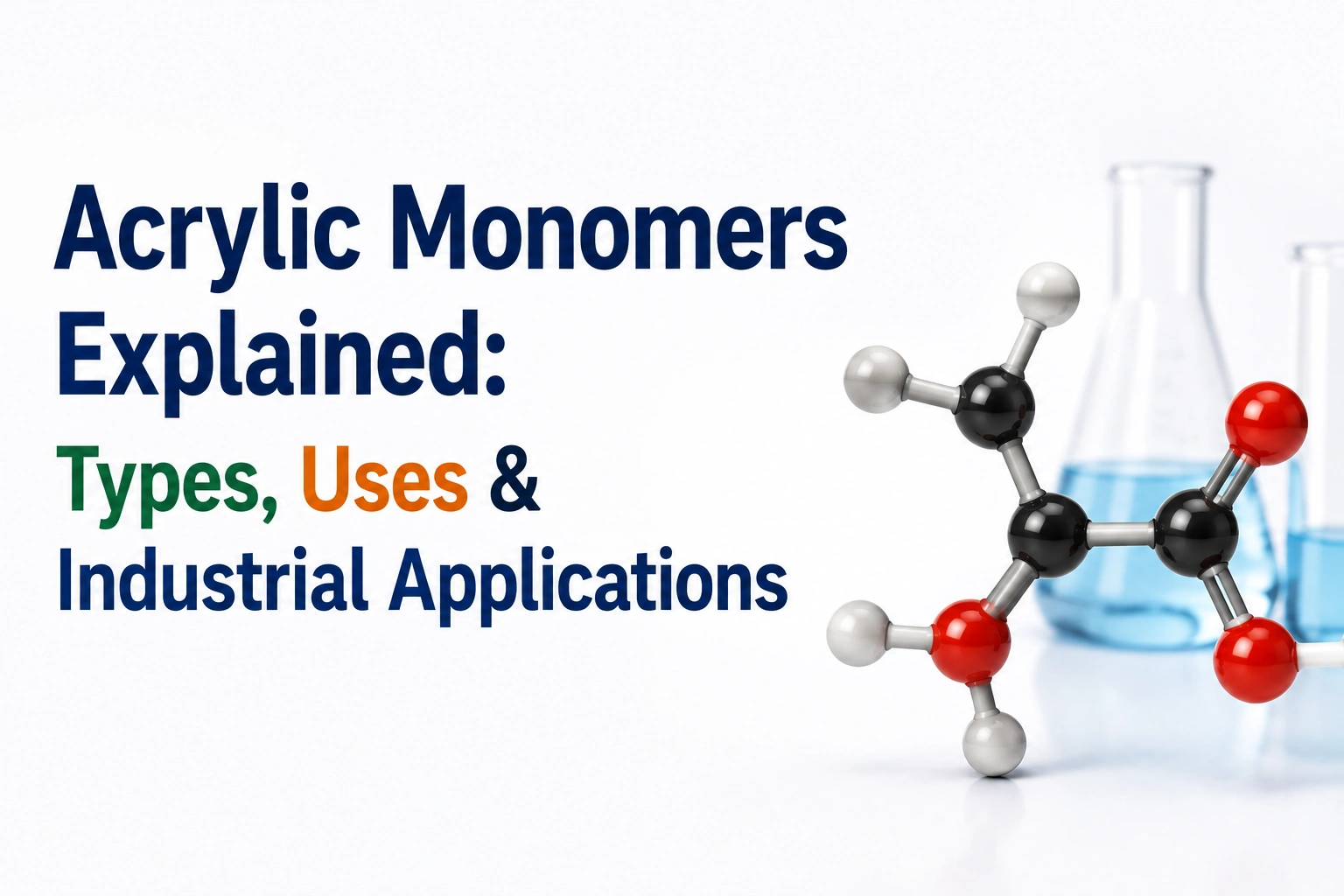
Acrylic Monomers Explained: Types, Uses & Industrial Applications
Posted on: August 25, 2026
Acrylic monomers are important building blocks in many industrial materials. They are used to produce coatings, adhesives, plastics, sealants, and other products that need specific performance properties. Their ability to polymerise makes them useful across several manufacturing sectors.
The term covers a wide range of chemical compounds. Each monomer can provide different properties such as flexibility, hardness, adhesion, weather resistance, or chemical stability. This allows manufacturers to select materials based on the final product requirements.
Understanding the main types of acrylic monomers also helps explain how acrylic polymers and other industrial materials are developed. For businesses working with coatings, plastics, adhesives or speciality chemicals, knowing these differences can support better material selection.
What Are Acrylic Monomers?
Acrylic monomers are small molecules that contain a reactive carbon-carbon double bond. This bond allows them to join with other molecules through polymerisation.
During this process, many monomer molecules link together to form larger molecules called polymers.
The basic relationship is simple: Monomer → Polymerisation → Polymer
Different monomers create polymers with different properties. Factors such as the chemical structure, functional groups and molecular weight can affect the final material.
Acrylate monomers are one important group within this wider category. They contain an acrylate functional group and are widely used as raw materials for coatings, adhesives, inks and plastics. For industrial manufacturers, choosing the right monomer is important because it can influence how the finished material performs.
Which Types of Acrylic Monomers Are Used in Industry?
Not all acrylic monomers perform in the same way. Their chemical structures allow manufacturers to develop materials for different applications.
Some common groups include:
Acrylates
Acrylates are widely used in coatings, adhesives, sealants and plastics. They can provide useful combinations of flexibility, adhesion and resistance.
Methacrylates
Methacrylates are closely related to acrylates but have a different molecular structure. They are used in applications where hardness, durability and optical properties are important.
Functional Acrylic Monomers
Some monomers contain additional functional groups. These groups can improve adhesion, crosslinking or compatibility with other materials.
The choice depends on the required end-use properties rather than simply the type of monomer.
How Do Acrylic Monomers Become Acrylic Polymers?
Polymerisation is the key step that converts monomers into useful polymer materials.
Acrylic monomers can undergo different polymerisation processes. These include free-radical polymerisation and other controlled processes used to manage molecular structure.
The reaction joins the carbon-carbon double bonds of individual monomers. As more monomers react, polymer chains are formed.
The resulting acrylic polymers can have properties such as:
- Good weather resistance
- Strong surface adhesion
- Optical clarity
- Flexibility
- Hardness
- Chemical resistance
- Resistance to ageing
Manufacturers can also combine different monomers to balance these properties.
For example, one monomer may improve flexibility while another increases hardness. This gives producers greater control over the final material.
What Are Acrylic Resins Used For?
Acrylic resins are polymeric materials made using acrylic-based monomers. They are valued for their balance of appearance and performance.
One major use is in coatings.
Acrylic-based coatings can provide good colour retention, weather resistance and surface protection. This makes them useful for industrial and architectural applications.
They are also used in:
- Automotive coatings
- Protective coatings
- Decorative paints
- Printing inks
- Adhesives
- Sealants
- Plastic products
The exact formulation depends on the intended application.
A coating designed for outdoor exposure may need stronger resistance to sunlight and weather. An adhesive may instead require better bonding and flexibility.
How Are Polymer Chemicals Used in Manufacturing?
Polymer chemicals form the basis of many modern materials. They are used to create products with specific physical and chemical properties.
Acrylic-based materials are particularly useful because their properties can be adjusted through monomer selection and formulation.
Manufacturers can modify factors such as:
- Hardness
- Flexibility
- Drying speed
- Adhesion
- Gloss
- Transparency
- Resistance to chemicals
- Resistance to weather
This flexibility is one reason acrylic chemistry has applications across several industries.
The final performance depends not only on the monomer but also on the polymerisation method, additives, processing conditions and formulation.
Where Are Acrylic Polymers Used?
The use of acrylic polymers extends across many industrial sectors.
| Industry | Common Applications |
| Automotive | Coatings, finishes and protective layers |
| Construction | Sealants, coatings and adhesives |
| Packaging | Coatings, inks and bonding materials |
| Electronics | Protective coatings and speciality materials |
| Paints | Decorative and industrial coatings |
| Adhesives | Bonding and pressure-sensitive products |
| Plastics | Modified polymer systems and components |
In automotive applications, acrylic materials can help provide durable finishes with good appearance.
In construction, they can be used in coatings and sealants where weather resistance is important. Packaging manufacturers may use acrylic materials in inks, coatings and adhesive systems. The application determines which combination of monomers and polymers is suitable.
Why Monomer Selection Matters in Acrylic Manufacturing
The selection of acrylate monomers affects the properties of the final polymer. A manufacturer cannot rely on one monomer for every application. Different products need different performance characteristics.
For instance, a flexible adhesive may need a softer polymer structure. A protective coating may require greater hardness and resistance. The molecular structure of each monomer plays a role in this balance.
Manufacturers may therefore combine two or more monomers to achieve the required performance.
Other factors also need consideration:
- Required polymer properties
- Processing temperature
- Reaction conditions
- Desired molecular weight
- Application requirements
- Compatibility with other ingredients
- Regulatory and safety requirements
Careful selection can help reduce formulation problems and improve consistency between production batches.
What Should Businesses Consider When Buying Acrylic Raw Materials?
Businesses sourcing acrylic materials should look beyond price alone. The quality and consistency of the raw material can affect downstream production. Variations in purity may influence polymerisation and final product performance.
A reliable supplier should be able to provide clear technical information about the material.
Important points to check include:
- Chemical specification
- Purity level
- Storage requirements
- Packaging options
- Batch consistency
- Technical documentation
- Supply capacity
- Application suitability
Storage conditions also matter. Many reactive monomers need controlled storage to maintain stability and minimise unwanted polymerisation. Businesses should follow the supplier’s recommended handling and storage instructions.
How Do Acrylic Monomers Support Product Development?
Acrylic chemistry gives manufacturers considerable scope to develop materials for specific applications.
The same basic monomer family can support products with very different properties when combined with other monomers and additives.
This makes acrylic resins useful in product development where performance needs can vary between industries.
For example, manufacturers may need:
- A hard and durable coating
- A flexible adhesive
- A clear plastic material
- A weather-resistant finish
- A fast-drying formulation
Each requirement can call for a different polymer structure. This ability to adjust performance is a major reason acrylic materials remain important in industrial manufacturing.
Choosing The Right Acrylic Chemistry for Industrial Use
Acrylic monomers are more than simple chemical building blocks. Their structure determines how they react and what properties the resulting polymer can provide.
Acrylate monomers are used across coatings, adhesives, inks and plastics. They can be combined with other monomers to create materials with controlled performance.
The resulting acrylic polymers can offer properties suited to demanding industrial applications. Meanwhile, acrylic resins provide useful solutions for coatings, adhesives and surface protection.
For B2B buyers, the right choice depends on the intended application, required specifications and processing conditions. A supplier with technical knowledge can help businesses identify suitable materials and maintain consistent supply.
Vinati Organics operates in specialty chemicals and organic intermediates, serving industrial customers across global markets. Their portfolio and manufacturing capabilities support applications that require consistent chemical quality and reliable supply. Businesses evaluating acrylic raw materials can contact Vinati Organics to discuss product requirements, specifications and suitable solutions.
Related Posts




 K&A
K&A